Real Estate Agents: Stop Chasing Every Marketing Strategy and Focus on What Actually Works
Posting on social media. Answering emails. Cold calling. Door knocking. Sending mailers. Building a website. Starting a YouTube channel. Filming. Editing. Writing descriptions. Optimizing for SEO. Designing thumbnails.
Just reading that list is exhausting. And if you're trying to do all of it at once, you're not building momentum, you're building a to-do list that never ends.
I see this all the time: agents spread thin across every marketing tactic they hear about, never giving one strategy enough attention to actually work. The problem isn't that you're doing too little. The problem is you're trying to do too much.
Today I want to break down why constantly switching strategies holds you back, what happens when you go deeper with one approach, and how to improve without starting all over again. I'll also share real client examples, including one agent who generated over $36 million in business through YouTube in 2025, and show you how to build something that compounds instead of constantly restarting.
Table of Contents
- Why Constantly Switching Marketing Strategies Holds You Back
- Why Going Deeper With One Strategy Matters
- Real Success Stories: Agents Who Focused and Won
- How to Improve Your Strategy Without Starting Over
- Connect Your Marketing to a Real Business Goal
- Track Your Results and Build on What Works
- When and How to Delegate So You Can Keep Growing
- Your Next Step: Create a Focused Action Plan
Why Constantly Switching Marketing Strategies Holds You Back
Distractions are everywhere. Your broker tells you to start cold calling. Someone in your office signs up for a new service and swears it's the key to growing your business. You see another agent posting videos on social media and wonder if you should be doing that too. Before long, you're trying to learn a new platform, test a new strategy, manage another subscription, and fit another activity into your already packed schedule.
Every new opportunity demands your attention. And when you say yes to everything, you end up spread so thin that nothing gets the focus it needs to actually move the needle.
Here's what I mean by focusing on one thing: you still need to serve your clients, answer important messages, manage transactions (unless you have a transaction coordinator), do your follow-up, and run your business as normal. But focusing on one thing means choosing one primary marketing approach that can build something consistently over time.
That could be YouTube, like what I'm doing right now. It could be cold calling, door knocking, geographic farming, referrals, or social media. Whatever it is, you want to make sure your activities run and support each other, not compete for your time and attention. Giving yourself a clear priority instead of treating every strategy as equally important is what makes the biggest difference.
When you're trying everything, you only get to the basics of each strategy. You never go deep enough to see what actually works. And without that depth, you never learn the details that create real results.
Why Going Deeper With One Strategy Matters

When you focus, you start to notice details. Let me use YouTube as an example, since that's the strategy I know best. When you go deeper with video marketing, you start to see which topics attract your ideal client, which titles create interest, where viewers lose attention, which call-to-actions generate responses, what questions keep engagement, and what videos lead to real conversations.
Those details help you improve. Depth gives you the opportunity to learn, something that constantly starting over takes away.
Your first video won't be like your 50th video. Think about doing something new. You probably weren't great at it when you started. Maybe you need to improve your delivery, your confidence, your scripts, the examples you use, the topics you select, or the call-to-actions you include. Your first video is a starting point, but each recording gives you another opportunity to get better.
Repetition works best when you review what you're doing and apply what you've learned. You have to be willing to look at your work, see what needs to improve, and make adjustments. That's how you build momentum.
Real Success Stories: Agents Who Focused and Won
Let me give you a real example. Zak Schmidt in DFW, Texas, built his content focusing on YouTube around his specific market and new construction. He answers the questions his future clients are asking. Based on the results he shared with us, he's already done over $36 million with his YouTube strategy being a part of that approach in 2025.
But think about what's behind that success: learning his market, recording the content, building a library of useful videos, answering questions before they come up, following up with people who go through his call-to-actions, and serving the clients who reach out. The content keeps working after it's published, but building the business still takes work, filming the content, putting it out, and staying consistent.
Here's another example. Alisha and Matthew focused on YouTube while working full-time jobs. In our conversations, they shared that in about four months they got their first lead. It took about a year before they got their first closing. And in the past 12 months, they've had 12 closings. You can watch their story on our channel to hear their results directly.
These are their results with their timeline. Your experience may be different, it may take longer or it could take shorter. It depends on timing, your approach, your consistency, and what have you. But imagine if they had stopped before their first lead, or stopped after getting a lead because it hadn't turned into a closing yet. Early activity and closed business don't always happen on the same schedule.
They improved their approach along the way. They didn't just keep posting without making adjustments. They worked on who they were speaking to, what topics to cover, how to structure the script, how to communicate clearly, and how to guide viewers toward their next steps. Once they saw something working, they studied it. Success leaves clues.
How to Improve Your Strategy Without Starting Over
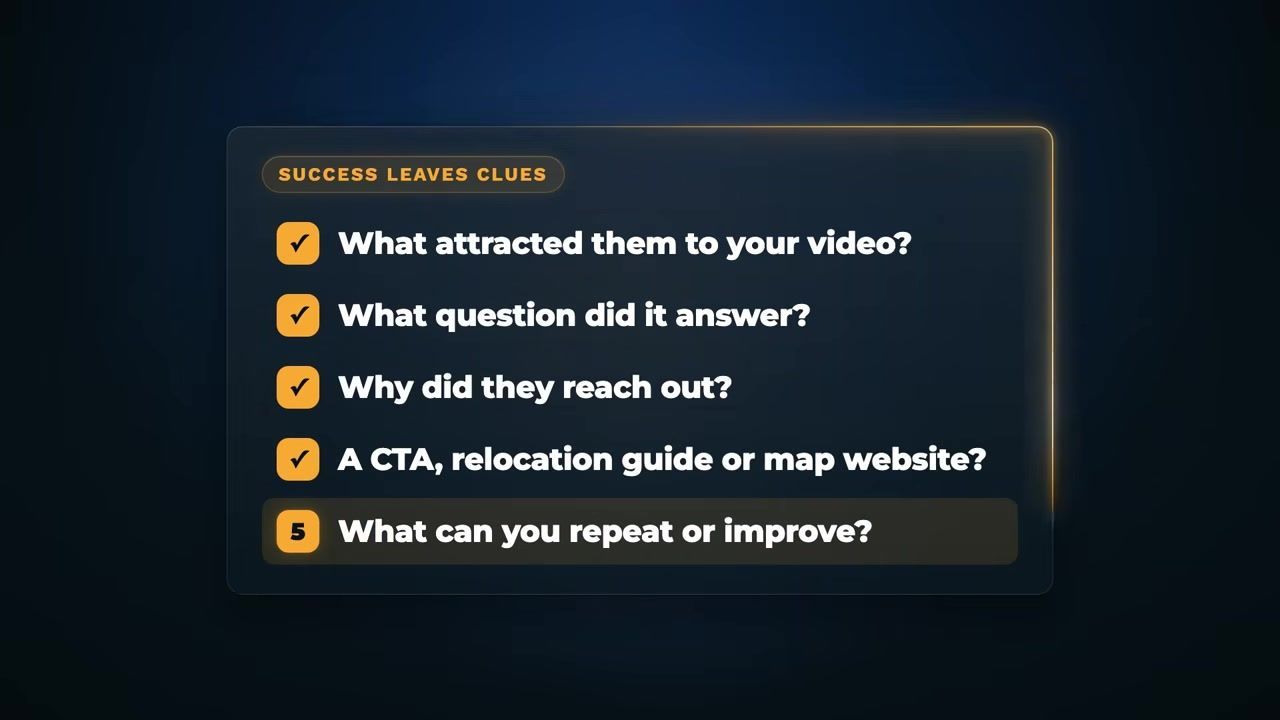
When something works, ask yourself these questions:
- What attracted this person to watch your video?
- What question did the video answer that you can do additional videos on?
- Why did they reach out? Was it a call-to-action, a relocation guide, the website with the map?
- What can you repeat or improve?
Use the results to shape your next move. That's a huge part of focusing on one thing, especially with a YouTube strategy.
Don't restart every time you get frustrated. Maybe you try something for two months, three months, six months, even a year before you get frustrated and change direction. Sometimes a change is needed, but first ask: Did I give this a fair test? Was I consistent? Did I reach the right audience? Did I improve my approach? Did I follow up? Did I measure anything? Did I get useful feedback?
Time passing isn't the same as executing a strategy well. Think about it like going to the gym. You don't walk into the gym, finish one workout, and expect the final results. You follow a process: you show up, stay persistent, track progress, make adjustments, recover, and repeat. Then you get results. Business requires the same willingness to work through the learning stage.
Progress may first show up as better conversations, more confidence, stronger content, more inquiries, better appointments, or appointments in general. Look for signs of progress while you work toward the bigger results. At the end of the day, it's a compound effect, the small things equal the bigger wins. Try not to just focus on the end result. Focus on the small wins. Be present.
Connect Your Marketing to a Real Business Goal
Alyssa and Matthew's goal was $500,000 in income before they quit their jobs. That's what they wanted to get to that point.
What is your goal? Maybe you want your first closing, more consistent appointments, a dependable structure of conversations, enough income to hire some support, or more control over your schedule. Get specific. Your marketing approach needs a purpose beyond keeping you busy. You want to make sure you know specifically what you want out of the activity you're putting forth.
Track Your Results and Build on What Works
Focusing on one thing doesn't mean repeating an approach forever without evaluating it. Choose a review schedule and track what matters for your strategy:
- Activities completed
- Conversations revisited
- Leads generated
- Appointments scheduled
- Clients signed
- Closings
- Time and money invested
Then ask: Where is the process working, and where is it breaking down? Maybe you need a better message, stronger follow-up, or the approach needs to change. Stay committed to the goal while being willing to improve the method.
When you get that first commission check, look back and ask yourself: Where did the client come from? What built their trust? What prompted them to reach out? What helped them move forward? Which parts can I repeat?
Success leaves clues. You literally just want to rinse and repeat what actually works. Then work toward your second, third, fourth, and fifth closing. When results give you something to investigate, repeat results help you understand what you can build around. Strengthen the process that's producing opportunities.
When and How to Delegate So You Can Keep Growing

As your business grows, you may be able to get help with video editing, thumbnails, titles, descriptions, social posting, listing promotion, turning your videos into blogs, all things we do here at Liftoff Agent, and administration work.
Start by identifying what's taking time away from the work you do best. If it's meeting clients and filming content, you do that and delegate the rest. Then establish clear responsibilities for the person helping you, a repeatable process, an expectation of outcome, and a way to review the work so you can help them have success with the process. Delegation works better when the person helping you knows what success looks like.
Your Next Step: Create a Focused Action Plan
Before you leave this video, give yourself one clear next step. Ask yourself: What is my primary marketing approach?
Then:
- Put the work on your calendar. Time-block it.
- Set a realistic target date.
- Decide when you'll measure success and results.
- Schedule a review to look at what's going well, what's not working well (especially if you're going into a YouTube approach).
- Identify one improvement to make next.
If something new comes along, you don't have to act on every idea immediately. Be smarter about what you do and how you do it. Protect your time and stay committed to your priorities.
Here's the big idea: You don't need every marketing strategy you hear about. You need to choose an approach you can execute, improve, and stay consistent with. Focus, consistency, feedback, improve, results. Then as the business starts to grow, document and delegate so you can grow even further.
Your next breakthrough may just come from going deeper with something you've already started. Give your strategy focused effort and use the evidence to guide what happens next. You got this. I believe in you.
Frequently Asked Questions
How long should I stick with one marketing strategy before switching?
Give it a fair test, at least six months to a year if you're being consistent and improving along the way. Time passing isn't the same as executing a strategy well. Ask yourself if you reached the right audience, improved your approach, followed up, and measured results before deciding to change direction.
What if I'm not seeing results after a few months?
Look for signs of progress beyond closed deals: better conversations, more confidence, stronger content, more inquiries, or appointments. Early activity and closed business don't always happen on the same schedule. Review where the process is working and where it's breaking down, then make adjustments.
How do I know which marketing strategy to focus on?
Choose an approach you can execute consistently and that aligns with a real business goal. It could be YouTube, cold calling, door knocking, geographic farming, referrals, or social media. Pick one that fits your strengths and the way you want to build your business, then go deep with it.
When should I start delegating parts of my marketing?
Delegate when tasks are taking time away from the work you do best, like meeting clients or filming content. Start by identifying repeatable tasks (editing, thumbnails, social posting, listing promotion) and establish clear responsibilities, processes, and expectations so the person helping you knows what success looks like.
What should I track to measure my marketing success?
Track activities completed, conversations revisited, leads generated, appointments scheduled, clients signed, closings, and time and money invested. Then ask where the process is working and where it's breaking down. Use the data to improve your method while staying committed to your goal.
How can Liftoff Agent help me focus on my marketing?
We help agents delegate video editing, thumbnails, titles, descriptions, social posting, listing promotions, and turning videos into blogs. If you're ready to delegate parts of your marketing and have the budget, set up a strategy call with us. We'll talk about what you're working on now, what's taking up your time, and what you could potentially delegate to support your next stage of growth.
We specialize in working with real estate agents and teams to build local authority. We do this through creating and managing your brand, website, video and social presence.
We'd love to chat and show you how you can dominate your local market and avoid wasted marketing dollars.
Subscribe to Newsletter